Tasks and turns
flowchart LR
  Task[Task] --> Session[Session on its branch]
  Session --> Turn1[Work turn]
  Session --> Turn2[Feedback turn]
  Session --> Review[Review turn]
  Turn1 --> Commits[Git commits]
  Turn2 --> Commits
A task is the unit of work in lazy: a goal, a prompt, and everything that happens while an agent works toward it. Work happens in turns, and a human steers by sending feedback between them.
Why it exists
An agent works for minutes or hours, then stops and waits to be reviewed. Lazy makes each of those stops a clear boundary. You read what changed, say what you want next, and the agent continues. Because the work lives in its own branch and worktree, many tasks run side by side without touching your checkout or each other.
The pieces
- Task. It has a short code, a goal, a prompt, a status, an optional
parent task, and a record of its turns, commits and comments. Create one
with
lazy createand run it withlazy start <task_id>. The status says where the task stands; see the task state machine. - Branch and worktree. Each task gets its own git branch, named with the
prefix from
[git] default_branch_prefix(defaultlazy, solazy/fix-bug), and its own git worktree under.lazy/worktrees/in your project. The agent edits only that worktree. Changing the prefix renames no existing branch. - Turn. One run of the agent: it starts from a prompt, works, and stops. Every turn is recorded with who or what started it. Only one turn runs on a task at a time. If a second request arrives while one runs, it is refused as busy and nothing you wrote is lost; send it again once the task is idle.
- Session. The continuity between turns of one task: the agent's conversation, so a later turn remembers earlier ones, plus the commits the task has recorded. Switching a task to an agent on a different harness (while no turn is running) starts a fresh agent conversation, because one harness's conversation cannot be resumed by another; two agents on the same harness keep it. A model, effort or agent chosen when you give feedback stays on the task for later turns, though switching agent re-picks model and effort for the new agent unless you set them in the same step.
- Subtask. A task with a parent. Its branch is cut from the parent's branch, and accepting it merges it into the parent. A cluster task is a parent whose agent runs its subtasks itself.
Who starts a turn
- You.
lazy startfor the first turn, thenlazy unblock(with your feedback) orlazy resume(no feedback) for later ones. You can alsolazy aska read-only question,lazy syncto merge upstream changes into the task's branch, andlazy stopto halt a running turn. - The builder. The builder is the agent you talk to to create and steer tasks. It starts and unblocks tasks through the same commands, over MCP.
- An agent, for its subtasks. A task's agent can start, unblock, resume, ask and sync its own subtasks. These turns are attributed to whoever owns the agent's own turn; see identity.
- The daemon. On its own the daemon resumes a task whose turn crashed
(
auto_resume, on by default; the crash and retry rules are in the state machine page), and, for a task with an open pull request, reacts to forge comments and CI results (auto_react_comments,auto_react_ci, both on by default). It also wakes a blocked cluster when a new child is added to it.
Builder and agent starts are bounded: [limits] max_turns_without_human
(default 10, 0 for unlimited) caps consecutive turns they start without a
human. A human action always resets the count.
In Lazy Teams, a project admin can set this budget under Settings → Configuration:
[limits]
max_turns_without_human = 10
After ten consecutive agent or builder starts, the task waits for a person to start its next turn.
How a turn ends
An agent can declare its work done with lazy_final, raise a blocking item when it needs a decision, or stop without either declaration. These endings are recorded separately from status: a finished turn normally leaves the task blocked (or conflict while a protected-file decision is due). A final declaration starts automatic review; it does not itself end the turn or gate a person's accept. A blocking item does gate accept until it is resolved.
Work left uncommitted when a turn ends
The task's diff and accept use commits, so an uncommitted edit is not part of the work offered for review. Before a writable turn closes, lazy asks the agent once to commit or discard loose files. If they remain, lazy names the paths on the turn and in a notice; accept refuses until the worktree is clean. Lazy never commits those files on the agent's behalf.
How feedback reaches the agent
The agent only sees your words in the prompt of a turn.
lazy unblock <task_id>starts the next turn with your feedback in its prompt. Give it inline with-m, from a file with-f, or leave both off and write it in your editor.lazy comment <task_id>saves a note and nothing else. It does not start a turn. The agent reads it in a block headed "NOTES ADDED SINCE YOUR LAST TURN" in the prompt of the nextunblock(or the task's first start). Until a note has been shown to the agent you can edit it with--edit. A note written while a turn is running is handed to that same turn before it ends.lazy askputs a question to the agent in a read-only turn. It does not consume queued comments, and the agent cannot change files in it.
Your feedback is saved before anything that can fail, so a failed launch does
not lose what you typed. Comments left on a pull request by reviewers are the
exception to "a comment starts nothing": with auto_react_comments on, the
daemon feeds them to the agent.
In each surface
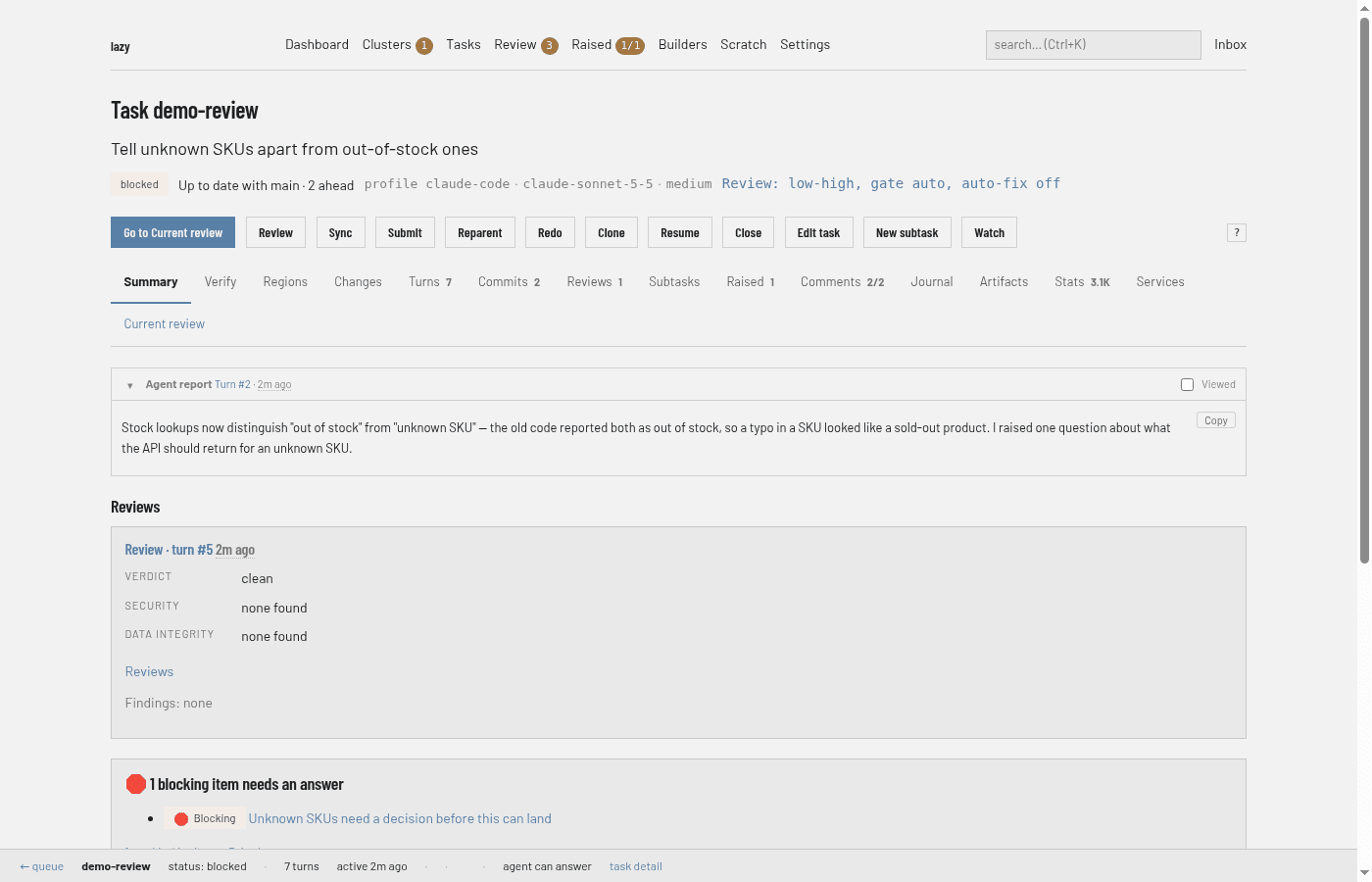
Daemon dashboard. The task page shows turns, comments and the actions for the current status; see the web review page.
CLI. Everything above is a command:
lazy create,start,unblock,comment,ask,resume,sync,stop.Lazy Teams (private alpha). The task page offers start, unblock, resume, stop and sync as single actions, plus comments on the code; see Lazy Teams task review.
Limits
In Lazy Teams, a project admin can set the watchdog under Settings → Configuration:
[agent]
watchdog_output_timeout_ms = 1800000
This gives an agent 30 minutes without a completed step before the watchdog stops its turn.
- A turn is dispatched only from
blocked,conflict,submittedorinterrupted(andbacklogfor the first start). A task being paired on or merged is never handed a turn. - An agent has no identity of its own; its work is attributed to the person who asked for the turn, or to the configured system identity when nobody did.
- Comments never wake a task. If you want the agent to act, unblock it.